Rigid Foam Board Insulation: The Heavy Lifter of High-Efficiency Homes (2025 Guide)
If fiberglass is the blanket you wrap around yourself, rigid foam board is the windbreaker that stops the chill from cutting through to your bones.
In the evolving landscape of 2025 home construction and renovation, homeowners are looking beyond the “fluffy stuff” inside the walls. They are discovering that the wood studs holding up their house are actually massive energy leaks. This phenomenon, known as thermal bridging, acts as a highway for heat to escape your home, bypassing your fiberglass batts entirely.
Enter Rigid Foam Board Insulation.
Often seen as those pink, blue, or foil-faced sheets stacked in the lumber aisle, rigid foam is the secret weapon of high-performance homes. It provides continuous insulation, superior moisture management, and structural integrity that soft insulation simply cannot match.
Whether you are finishing a damp basement in upstate New York or looking to wrap your home’s exterior in a thermal shield, this guide will walk you through the types, applications, and installation secrets of rigid foam board.
The “Thermal Bridge” Problem: Why You Need Rigid Foam
To understand why rigid foam is essential, you have to understand how a wall works. In a standard wood-framed house, about 25% of the wall area is wood (studs, plates, headers). Wood has a terrible R-value (about R-1 per inch).
Even if you pack the cavities with R-20 fiberglass, that 25% of wood is only performing at R-3.5 or R-5.5. In the dead of a New York winter, you can actually see “ghost lines” on your walls where the studs are cold.
Rigid foam solves this. By installing it as a continuous layer over the studs (either inside or outside), you break that thermal bridge, forcing the cold to travel through insulation before it touches your framing.
For a broader look at how different insulation types work together to stop heat loss, check out The Ultimate Guide to Home Insulation: Comfort, Savings, and Efficiency in 2025.
Make Rigid Foam Your 2025 Efficiency Upgrade – Free Assessment Awaits!
Unlock high-efficiency with rigid foam boards: choose EPS for breathability (R-3.6–4.0/inch), XPS for moisture resistance (R-5.0/inch), or Polyiso for top performance (R-6.0–6.5/inch) to stop thermal bridges, cut heat loss through studs (~25% of walls), and create continuous insulation in basements, exteriors, or slabs. Gain better moisture control, durability, and comfort in NY winters. Claim 30% tax credits (up to $1,200) and stack NY rebates. Pro install recommended for best results – get a FREE in-home energy assessment from the New York Weatherization Program to evaluate your home, explore no-cost upgrades, and maximize savings today!
The Three Kings of Rigid Foam: EPS, XPS, and Polyiso
Not all foam boards are the same. Walking into a hardware store can be confusing because they all look like “styrofoam,” but they have vastly different properties.
1. Expanded Polystyrene (EPS)
-
Visual: The white, bead-board stuff (looks like a coffee cup).
-
R-Value: R-3.6 to R-4.0 per inch.
-
The Lowdown: EPS is the most affordable option. It is essentially air bubbles trapped in plastic beads.
-
Best Use: It is surprisingly permeable to water vapor, meaning it can “breathe” slightly better than others. It is often used for insulating concrete forms (ICFs) or under roofing. Because it is the cheapest, it’s great for projects where thickness isn’t an issue and you just need raw R-value per dollar.
2. Extruded Polystyrene (XPS)
-
Visual: The smooth Pink (Owens Corning) or Blue (Dow) boards.
-
R-Value: R-5.0 per inch.
-
The Lowdown: XPS is denser and stronger than EPS. It is a fantastic vapor retarder (semi-impermeable).
-
Best Use: This is the king of basement walls and concrete slabs. Because it resists water absorption better than EPS, it is the standard choice for below-grade applications. If you are insulating a basement wall before framing, this is likely what you want.
3. Polyisocyanurate (Polyiso)
-
Visual: Usually yellowish foam sandwiched between foil facings.
-
R-Value: R-6.0 to R-6.5 per inch (The highest of the three).
-
The Lowdown: Polyiso is the high-performance option. The foil facing adds a radiant barrier component. However, it has a weakness: its R-value can actually decrease slightly in extreme cold, though modern formulations have improved this.
-
Best Use: Exterior wall sheathing (under siding) and attic hatches. It takes up the least space for the most warmth.
Where Rigid Foam Shines (The Killer Applications)
While you can put rigid foam anywhere, there are three specific areas where it outperforms everything else.
1. The Basement Wall Retrofit
Basements are tricky. If you put fiberglass against a cold concrete wall, moisture will condense, wet the fiberglass, and grow mold.
-
The Fix: Glue 2-inch sheets of XPS (Pink/Blue board) directly to the concrete. Tape the seams with Tyvek tape.
-
The Result: You create a vapor barrier that keeps the humid basement air away from the cold concrete, stopping condensation dead in its tracks. You can then frame your 2×4 wall inside of that foam.
2. Continuous Exterior Insulation
If you are re-siding your house in 2025, adding 1 inch of rigid foam over your old plywood sheathing is a game-changer.
-
The Fix: Wrap the whole house in rigid foam before the new siding goes on.
-
The Result: This acts like a thermos cooler for your house, keeping the structural wood warm and dry.
3. Slab-on-Grade Floors
If you are pouring a new concrete floor or a heated driveway.
-
The Fix: Lay down high-density XPS foam before the concrete is poured.
-
The Result: The ground is a massive heat sink. Without foam, your heated floor is heating the earth. With foam, the heat reflects up into your home.
Installation Masterclass: Do It Right
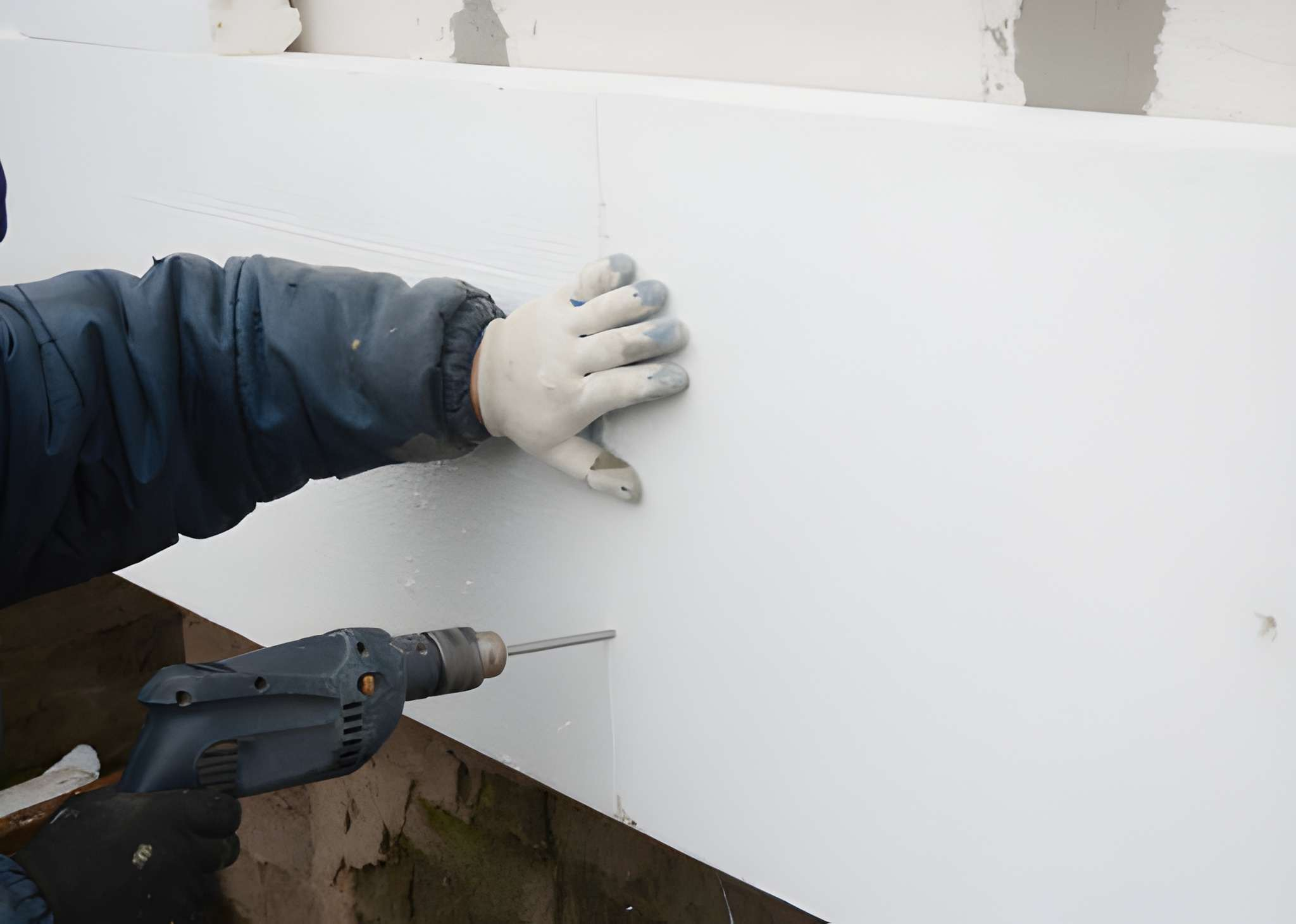
Rigid foam is easy to work with, but easy to mess up. Here is the technical advice you need to follow:
-
Cutting:
-
Thin boards (1″ or less): Score it with a utility knife and snap it like drywall.
-
Thick boards (2″+): Use a table saw or a dedicated foam saw. Warning: Table saws create a “snowstorm” of plastic dust. Wear a mask and do it outside.
-
-
Adhesives:
-
CRITICAL: Do not use standard construction adhesive (like Liquid Nails) unless it specifically says “Foam Board Compatible.” Standard solvents will melt the foam, eating holes right through your expensive insulation. Look for “Foam Board Adhesive” or use low-expansion foam to stick it to walls.
-
-
Sealing is Believing:
-
Just butting the boards together isn’t enough. You must tape the seams. Use high-quality sheathing tape (red or white technical tape), not duct tape. Duct tape will fall off in 2 years.
-
The 2025 Economic Angle: Cost vs. Value
Rigid foam is more expensive than fiberglass.
-
Fiberglass: ~$0.50 per board foot.
-
Rigid Foam: ~$1.00 – $1.80 per board foot.
However, the calculation changes when you consider the 25C Energy Efficient Home Improvement Credit. Just like with other insulation types, the IRS allows you to claim 30% of the material cost for qualified insulation products, up to $1,200 per year.
Because rigid foam is a material-heavy cost (low labor if you DIY), it is an excellent candidate for this tax credit. If you spend $3,000 on Polyiso boards for your exterior renovation, you can get a significant chunk back at tax time.
If you are in New York and looking for specific rebates that might stack with federal credits, visit nyweatherizationprogram.com to check for state-specific incentives like EmPower+ or Comfort Home programs.
Safety Warning: The Fire Factor
There is one major downside to rigid foam: It is flammable. When it burns, it produces thick, toxic black smoke.
The Code Requirement: You generally cannot leave rigid foam exposed in a living space, garage, or attic storage area. It must be covered by a “thermal barrier”—usually 1/2-inch drywall.
-
Exception: Some specific foil-faced Polyiso boards are rated to be left exposed in crawl spaces or attics (check the fire rating on the label: “Class A” or “Class 1” fire rating is good, but “Ignition Barrier” code compliance is the key).
Make Rigid Foam Your 2025 Efficiency Upgrade – Free Assessment Awaits!
Unlock high-efficiency with rigid foam boards: choose EPS for breathability (R-3.6–4.0/inch), XPS for moisture resistance (R-5.0/inch), or Polyiso for top performance (R-6.0–6.5/inch) to stop thermal bridges, cut heat loss through studs (~25% of walls), and create continuous insulation in basements, exteriors, or slabs. Gain better moisture control, durability, and comfort in NY winters. Claim 30% tax credits (up to $1,200) and stack NY rebates. Pro install recommended for best results – get a FREE in-home energy assessment from the New York Weatherization Program to evaluate your home, explore no-cost upgrades, and maximize savings today!
Conclusion: Is Rigid Foam Worth It?
In 2025, if you are serious about energy efficiency, rigid foam is not optional—it’s a component of the system.
-
It is the only way to properly insulate a basement.
-
It is the best way to stop thermal bridging on exterior walls.
-
It provides the highest R-value per inch for tight spaces.
While it costs more upfront than batts, the durability (it doesn’t sag or settle) and the moisture protection make it a “buy it once” investment.
Start by assessing your home’s “weak points.” Is the basement cold and musty? Are the floors freezing? Those are jobs for rigid foam. For a comprehensive plan on how to integrate foam board into your whole-house strategy, read through The Ultimate Guide to Home Insulation: Comfort, Savings, and Efficiency in 2025.
Rigid foam is the shield that protects your home’s comfort. Don’t build without it.